Overview
This case study reanalyses data from Langlois
et al. (2005) to examine whether large reef-associated predators
(rock lobster and snapper) structure adjacent soft‑sediment communities.
The analysis demonstrates the use of full subsets GAMMs
in the FSSgam package, accounting for nested random effects
and zero‑inflated abundance data.
Background
In ecology, ‘haloes’ have been described in many contexts (Suchanek 1978; Fairweather 1988) and generally are thought to result from a predator or herbivore foraging given distances from a ‘shelter habitat’ out into a ‘food habitat’. Studies in temperate marine ecosystems have found ‘infaunal haloes’, areas of decreased density of soft-sediment fauna adjacent to reefs, at a variety of scales (0-30 m, (Davis et al. 1982); 0-70 m, (Posey and Ambrose 1994)). The model suggesting reef-associated predators are responsible for haloes is supported by studies of gut contents of fish on temperate reefs (Lindquist et al. 1994). However, convincing demonstrations of predators causing haloes of prey in these systems have been hampered due to limited replication of caging studies (Posey and Ambrose 1994) and the lack of large-scale manipulations (Thrush et al. 2000).
The most conspicuous predators associated with reefs in northeastern New Zealand are the sparid fish Pagrus auratus (snapper) and the rock lobster Jasus edwardsii. They are highly targeted by local fisheries and occur at higher densities inside no‑take marine reserves (NTR, Babcock et al. 1999). In this region the influence of predators on rocky reefs has been examined using the existing large-scale experimental framework provided by marine reserves (Babcock et al. 1999; Shears and Babcock 2002). Using this approach, Langlois et al. (2005) examined the potential role of large reef-associated predators in structuring adjacent soft-sediment communities, by contrasting the densities of predators and prey found inside versus outside three NTR.
Unlike a Before-After-Control-Impact (Underwood 1993) designed study, a potential problem with studies of established NTR is that evidence of a negative relationship between predator densities and densities of prey does not eliminate other potential models (Hurlbert 1984; Underwood et al. 2000). Results might be confounded by other factors that may structure the soft-sediment community (e.g. wave action, sediment grain-size distributions, organic matter, infaunal interactions). In the original study, Langlois et al. (2005) hypothesised that predation by large reef-associated predators would result in lower densities of large (> 4 mm) soft-sediment macrofauna inside reserves compared to outside reserves (Predator model). A further hypothesis was that predation would decrease with increasing distances from the reef, resulting in a ‘halo’ pattern in the community (Posey and Ambrose 1994), i.e., an increase in prey densities with increasing distances from the reef edge (Distance model).
In the original study, Langlois et al. (2005) investigated the influence of measured environmental variables (see the variable table in Methods, below) on the abundance composition of the assemblage inside and outside multiple NTR using multivariate multiple regression, which found no evidence that any of the measured environmental variables were confounding the comparison of the soft-sediment assemblages inside and outside the multiple NTR. To estimate effects on individual taxa inside and outside the NTR across the multiple random sites and multiple NTR locations, the original analysis used a mixed-model ANOVA, where P-values were obtained using permutations (Anderson and Braak 2003), to account for the great many zeros contained in the data. Any influence of the multiple environmental variables measured could not be accounted for in the original analysis of individual taxa due to the limited error families available in GLMM routines at that time. As a consequence it was impossible to tease apart the relative importance of NTR status and distance from the reef edge from variation in snapper or rock lobster density or the influence of measured environmental variables on the individual infaunal taxa. The revised analyses here based on a full subsets multiple regression approach allows the influence of environmental and predator density variables to be assessed independently, whilst accounting for the nesting of random sites inside and outside multiple random NTR and samples collected along a transect of fixed distance from the reef edge.
Methods
In 2002 New Zealand’s northeastern bioregion contained eight reserves, three of which were considered broadly comparable biotype replicates (Shears and Babcock 2003; Willis et al. 2003). This study was carried out between January and March of 2002, using these three locations as a random factor to explicitly test the generality of any potential differences in the effects of marine reserve status (as in Beck 1997). The Cape Rodney to Okakari Point (Leigh) Marine Reserve (36°16’S, 174°48’E) was gazetted in 1975, the Tawharanui Marine Park (36°22’S, 174°50’E) was declared a no-take area in 1981 and the Te Whanganui a Hei (Hahei) Marine Reserve (36°50’S, 175°49’E) was gazetted in 1993. At each location eight sites of similar wave exposure and reef/soft-sediment interfaces were chosen, four inside and four outside each marine reserve, with non-reserve sites interspersed both north and south of the reserve to mitigate the potential confounding influence of other environmental variables (such as recruitment or food supply).
Within each site, sampling was done at each of four distances from the reef edge: 2, 5, 15 and 30 m. These distance strata were comparable to previous studies of infaunal haloes (Posey and Ambrose 1994) and within the likely foraging ranges of snapper (Parsons et al. 2003) and rock lobster (Kelly et al. 1999). At each distance, six replicate samples were obtained using box quadrats measuring 0.5 m2 (1 m x 0.5 m) x 13 cm deep (0.065 m3). Sediment was excavated by hand with a metal scoop and sieved in the field using a sieve with a 4 mm mesh. Other studies from different systems (Ambrose 1991; Lindquist et al. 1994; Posey and Ambrose 1994; Dahlgren et al. 1999) have focused on smaller infauna (> 0.5 mm) where the corresponding reef-associated predators were also smaller. In the present study, we focused on larger infauna (> 4 mm), corresponding to the larger reef-associated predators found within reserves (snapper are ~316 mm mean total length and rock lobster are ~109.9 mm mean carapace length inside reserves, (Babcock et al. 1999)). Organisms retained on the sieve were preserved in 5% formalin and later transferred to 70% ethanol, and identified to the lowest taxonomic resolution possible.
Physical environmental variables measured at each distance stratum at each site included replicate measurements of grain size by dry sieving, organic content by ignition at 550°C, and bed form measurements. Wave exposure was estimated using an index of potential fetch (Thomas 1986). Estimates of the density of snapper at the reef edge were obtained using baited underwater video (BUV, Willis and Babcock 2000). Estimates of the density of lobster at the reef edge were obtained by underwater visual census (UVC, MacDiarmid 1991). A list and brief description of the environmental variables measured and subsequently included in analyses are given below.
| Variable | Description |
|---|---|
| Snapper | Density of legal-sized snapper (Pagrus auratus) estimated by BUV |
| Rock Lobster | Density of legal-sized rock lobster (Jasus edwardsii) estimated by UVC |
| Predatory Infauna | Infauna considered to be predators (Langlois et al. 2005) |
| Bioturbating Infauna | Infauna considered to be bioturbators (Langlois et al. 2005) |
| Grain size fractions | Percentage of grain sizes of ambient sediments (by weight), from 125 um up to 4 mm |
| Organics | Sediment organic matter (%) |
| Bed Stress | Estimated using bed form ripple measurements and depth |
| Exposure | Estimation of fetch (km) |
| Depth | Water depth (m) |
Analysis
A generalised additive mixed model with full subsets analyses was
used to determine if NTR status, distance from the reef edge, variation
in snapper or rock lobster density or the influence of any measured
environmental variables or interactions between these predictors best
explained variance in abundance of the three most abundant and
ubiquitous infaunal taxa. Abundance data were modelled using a tweedie
distribution, implemented via a call to gam (mgcv, (Wood 2017)) with the random effect of site
included using the bs='re' specification. Smoothers to the
random factors of NTR location and nested sites (bs='re')
were included in all models (and as part of the null model) via the
null.terms argument of the full subsets gam function. Given
the complexity of the null model, the total number of predictors was
limited to only an additional three terms
(max.predictors=3) and k was limited to 3. As
the density of legal-sized lobster and snapper and NTR status were all
relevant to the primary hypothesis, the most parsimonious models within
2 AIC units of the top model that contained any of these variables in
addition to any habitat variables were considered as the most
parsimonious. The R language for statistical computing (R Core Team 2017) was used for all data
manipulation (dplyr, Wickham and Francois 2016;
tidyr, Wickham 2017), analysis (mgcv, Wood
2011) and graphing (ggplot2, Wickham 2009;
gridExtra, Auguie 2016).
** note ** This example was updated on the 11th Oct 2018 to demonstrate usage of the replacement functions generate_model_set and fit_model_set that have now superseded full.subsets.gam in package FSSgam Between them these functions carry out the same analysis, take the same arguments and return the same outputs as full.subsets.gam with the only difference being that the model set generation and model fitting procedures are separated into two steps. This was done to make the function easier to use, because the model set can be interrogated, along with the correlation matrix of the predictors before model fitting is even attempted.
It has since been updated with minimal changes on the 29th April 2026 to ensure reproducibility and to convert it to a .Rmd file for the vignette format for githubio.
It was updated again on the dev branch to call generate_model_set and fit_model_set, the snake_case names that generate.model.set and fit.model.set were themselves renamed to. The old dot-case names still work (they now just emit a deprecation warning and forward to the new names), but new code should call generate_model_set/fit_model_set directly.
It was updated again on the 7th September 2026 against FSSgam 1.1.0.9000. The results in this case study changed at that point, and the change is a correction. Under FSSgam 1.0.0 the candidate models were fitted with a Tweedie power parameter of about 1.01 instead of the value estimated for the model, which inflated both the estimated degrees of freedom and the information criteria. The candidate set, the formulae and the data are identical either way; only the fitted variance function differed. See ‘Relationship to the published table’ below for the measured effect.
The combined six-panel figure of the most parsimonious models was relaid out on the 7th September 2026. Only its presentation changed: the same six panels are drawn from the same fits, in the same order and with the same (a)-(f) labels. The figure is now given an explicit size, the panel text was reduced from 15 pt so that the axis titles are not cut off, the Status key is drawn once for the whole figure instead of over the bars of panel (a), and each row’s leftmost panel is labelled with the response axis.
Script information
Part 1-FSS modeling
This script is designed to work with long format data - where response variables are stacked one upon each other (see http://tidyr.tidyverse.org/)
There are two random factors, Site and NTR location We have used a Tweedie error distribution to account for the high occurence of zero values in the dataset. We have implemented the ramdom effects and Tweedie error distribution using the mgcv() package
Part 1-FSS modeling
Data preparation
dat <-case_study2 %>%
  rename(response=Abundance)%>%
  #   Transform variables
  mutate(sqrt.X4mm=sqrt(X4mm))%>%
  mutate(sqrt.X2mm=sqrt(X2mm))%>%
  mutate(sqrt.X1mm=sqrt(X1mm))%>%
  mutate(sqrt.X500um=sqrt(X500um))%>%
  na.omit()%>%
  mutate(Location=factor(Location)) |>
  mutate(Site=factor(Site)) |>
  mutate(Status=factor(Status)) |>
  glimpse()
## Rows: 285
## Columns: 25
## $ sediment <dbl> -3.2625005, -3.4838280, -4.6855602, -3.2486536, -3.4328005…
## $ Location <fct> Hahei, Hahei, Hahei, Hahei, Hahei, Hahei, Hahei, Hahei, Ha…
## $ Status <fct> Fished, Fished, Fished, Fished, Fished, Fished, Fished, Fi…
## $ Site <fct> Cooks Beach Inner, Cooks Beach Inner, Cooks Beach Inner, C…
## $ Distance <int> 2, 5, 15, 30, 2, 5, 30, 2, 5, 15, 30, 2, 5, 15, 30, 2, 5, …
## $ depth <int> 12, 12, 12, 12, 9, 9, 9, 10, 10, 12, 12, 10, 10, 11, 11, 1…
## $ X4mm <dbl> 3.16462, 1.69129, 1.67228, 0.79670, 0.03768, 0.23887, 0.05…
## $ X2mm <dbl> 1.41119, 1.62811, 1.01193, 0.77126, 0.25556, 0.57024, 0.41…
## $ X1mm <dbl> 3.88962, 4.86726, 3.97180, 1.82919, 2.09768, 3.42348, 2.96…
## $ X500um <dbl> 8.69694, 9.92831, 21.37884, 7.81927, 15.76419, 18.22572, 1…
## $ X250um <dbl> 70.31984, 69.18594, 64.74207, 78.20548, 67.41767, 62.77750…
## $ X125um <dbl> 6.19663, 5.70317, 2.75041, 5.26789, 7.21756, 7.48086, 2.31…
## $ X63um <dbl> 6.25038, 6.92941, 4.42267, 5.27693, 7.08857, 7.17101, 3.47…
## $ fetch <dbl> 2232582.5, 2232582.5, 2232582.5, 2232582.5, 1027166.9, 102…
## $ org <dbl> 3.45785, 3.19104, 2.80046, 2.78881, 2.47510, 2.52552, 2.30…
## $ snapper <dbl> 0.0, 0.0, 0.0, 0.0, 0.0, 0.0, 0.0, 0.0, 0.0, 0.0, 0.0, 0.0…
## $ lobster <dbl> 0.0, 0.0, 0.0, 0.0, 0.2, 0.2, 0.2, 0.0, 0.0, 0.0, 0.0, 0.0…
## $ InPreds <dbl> 0.0000000, 0.0000000, 0.0000000, 0.3333333, 0.0000000, 1.0…
## $ BioTurb <dbl> 0.1666667, 0.1666667, 0.8333333, 0.3333333, 0.3333333, 0.1…
## $ Taxa <chr> "BDS", "BDS", "BDS", "BDS", "BDS", "BDS", "BDS", "BDS", "B…
## $ response <int> 0, 1, 0, 1, 6, 5, 1, 0, 0, 0, 0, 0, 0, 1, 3, 0, 4, 0, 2, 0…
## $ sqrt.X4mm <dbl> 1.7789379, 1.3004961, 1.2931667, 0.8925805, 0.1941134, 0.4…
## $ sqrt.X2mm <dbl> 1.1879352, 1.2759741, 1.0059473, 0.8782141, 0.5055294, 0.7…
## $ sqrt.X1mm <dbl> 1.9722120, 2.2061868, 1.9929375, 1.3524755, 1.4483370, 1.8…
## $ sqrt.X500um <dbl> 2.9490575, 3.1509221, 4.6237258, 2.7962958, 3.9704143, 4.2…Predictor selection
pred.vars=c("depth","X4mm","X2mm","X1mm","X500um","X250um","X125um","X63um",
            "fetch","org","snapper","lobster")

factor.vars <- c("Status")
Predictor variables Removed at first pass included: broad.Sponges and broad.Octocoral.Black and broad.Consolidated , “InPreds”,“BioTurb” are too rare
Check for correalation of predictor variables- remove anything highly correlated (>0.95)—
##         depth  X4mm  X2mm  X1mm X500um X250um X125um X63um fetch   org snapper
## depth    1.00  0.24  0.05 -0.01   0.02   0.10  -0.08  0.03  0.21  0.05   -0.16
## X4mm     0.24  1.00  0.52  0.21   0.03   0.13  -0.20  0.48  0.03  0.23   -0.11
## X2mm     0.05  0.52  1.00  0.91   0.58   0.10  -0.51  0.01  0.28  0.13    0.08
## X1mm    -0.01  0.21  0.91  1.00   0.80   0.09  -0.60 -0.17  0.38  0.06    0.14
## X500um   0.02  0.03  0.58  0.80   1.00   0.21  -0.74 -0.13  0.46  0.00    0.07
## X250um   0.10  0.13  0.10  0.09   0.21   1.00  -0.80  0.07  0.16  0.10   -0.22
## X125um  -0.08 -0.20 -0.51 -0.60  -0.74  -0.80   1.00 -0.05 -0.37 -0.09    0.10
## X63um    0.03  0.48  0.01 -0.17  -0.13   0.07  -0.05  1.00 -0.23  0.11   -0.11
## fetch    0.21  0.03  0.28  0.38   0.46   0.16  -0.37 -0.23  1.00  0.15    0.16
## org      0.05  0.23  0.13  0.06   0.00   0.10  -0.09  0.11  0.15  1.00    0.16
## snapper -0.16 -0.11  0.08  0.14   0.07  -0.22   0.10 -0.11  0.16  0.16    1.00
## lobster  0.09 -0.10  0.03  0.11   0.12  -0.24   0.10 -0.04  0.11  0.14    0.54
##         lobster
## depth      0.09
## X4mm      -0.10
## X2mm       0.03
## X1mm       0.11
## X500um     0.12
## X250um    -0.24
## X125um     0.10
## X63um     -0.04
## fetch      0.11
## org        0.14
## snapper    0.54
## lobster    1.00
Note that nothing is highly correlated
Each predictor is plotted raw, square-root transformed and log(x + 1) transformed, so the three can be compared directly. The aim is an even spread across the range rather than a pile-up at one end; the rug marks where the samples actually lie. The original version of this comparison was written as a base R loop by Anna Cresswell.
dat |>
  select(all_of(pred.vars)) |>
  pivot_longer(everything(), names_to = "predictor", values_to = "value") |>
  mutate(predictor = factor(predictor, levels = pred.vars)) |>
  filter(!is.na(value)) |>
  mutate(raw = value,
         `square root` = sqrt(value),
         `log(x + 1)`  = log(value + 1)) |>
  select(-value) |>
  pivot_longer(c(raw, `square root`, `log(x + 1)`),
               names_to = "transformation", values_to = "x") |>
  mutate(transformation = factor(transformation,
                                 levels = c("raw", "square root", "log(x + 1)"))) |>
  ggplot(aes(x)) +
  geom_histogram(bins = 15, fill = "grey75", colour = "grey30", linewidth = 0.15) +
  geom_rug(sides = "b", alpha = 0.3) +
  facet_wrap(~ predictor + transformation, scales = "free", ncol = 3) +
  labs(x = NULL, y = "Number of samples") +
  theme_bw(base_size = 8)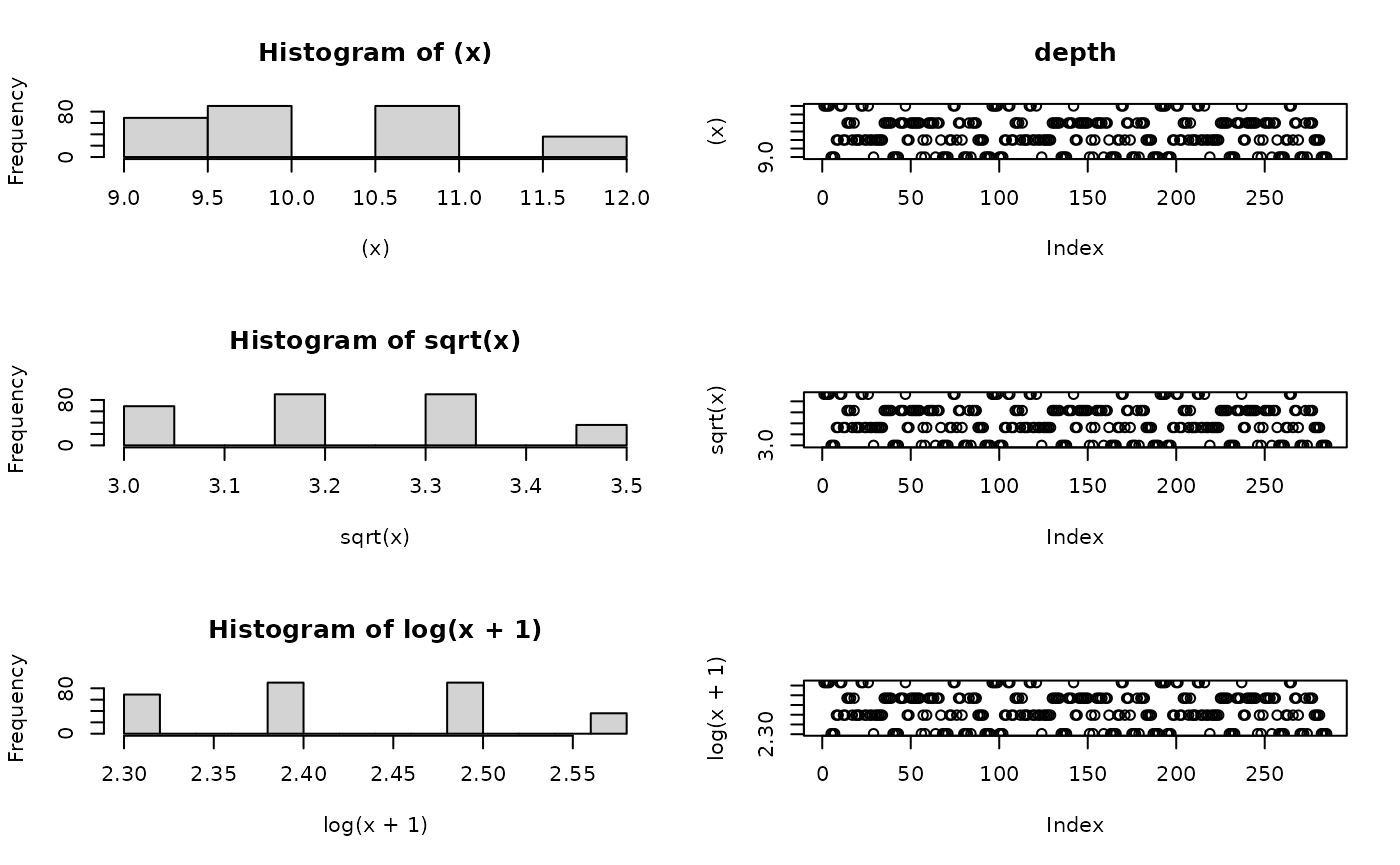
Review of individual predictors - we have to make sure they have an even distribution.
If the data are squewed to low numbers try sqrt>log or if skewed to high numbers try ^2 of ^3 Decided that X4mm, X2mm, X1mm and X500um needed a sqrt transformation
Decided Depth, x63um, InPreds and BioTurb were not informative variables.
Re-set the predictors for modeling.
pred.vars=c("sqrt.X4mm","sqrt.X2mm","sqrt.X1mm","sqrt.X500um",
            "fetch","org","snapper","lobster")
Screening taxa
Check that no response vector is more than 80% zeros.
This screen is applied before any model is fitted, and deliberately so. A taxon recorded as absent at almost every sample carries very little information about the predictors, but it still costs a full model set to find that out, and the fits that do converge are driven by a handful of non-zero records. Screening first is cheaper than interpreting the output afterwards. The 80% threshold is a convention rather than a rule; what matters is that the choice is made explicitly and stated.
unique.vars=unique(as.character(dat$Taxa))
unique.vars.use=character()
for(i in 1:length(unique.vars)){
  temp.dat=dat[which(dat$Taxa==unique.vars[i]),]
  if(length(which(temp.dat$response==0))/nrow(temp.dat)<0.8){
    unique.vars.use=c(unique.vars.use,unique.vars[i])}
}
unique.vars.use
## [1] "BDS" "BMS" "CPN"“BDS” bivalve Dosina subrosea
“BMS” bivalve Myadora striata
“CPN” crustacean Pagrus novaezelandiae
Three practical points about the call below.
max.models is a guard, not a target. It
is set to 600 here against a set of 139 candidates, so it never binds.
fit_model_set() stops rather than fitting when the set is
larger, because a full subsets set grows quickly and it is easy to
request one that takes days without meaning to. If the limit is reached,
raising it is rarely the right first move: reduce
max.predictors, or drop predictors, and only then raise the
limit.
Status survives the null.cov.cutoff
screen even though it is perfectly correlated with
Location. null.cov.cutoff, added to
generate_model_set() after the original paper, drops a
predictor correlated above 0.8 with a variable named in
null.terms, because a term forced into every candidate
should not be competing with a candidate for the same variation. Here
null.terms is s(Location,Site,bs='re') and
Status is nested within Location, so their
correlation is 1. Variables inside a bs='re' smooth are
excluded from the screen for exactly this reason: a random effect
grouping factor is correlated with what is measured within it by
construction, and that is the design of the study rather than
collinearity to remove. If the random effect were specified some other
way, Status would be dropped and a warning would name
it.
Check failed.models before reading anything
else. fit_model_set() catches a candidate that
fails and records the error against the model name rather than stopping.
An empty list is what you want. A few failures are usually a
k set too high for the data in one term; many failures
usually mean the test.fit or the predictor set is wrong,
not that individual models are unlucky. The recorded formula can be
fitted by hand outside the call to see the error in full.
Full subsets GAMM analysis
resp.vars=unique.vars.use
use.dat=dat
factor.vars=c("Status")# Status as a Factor with two levels
out.all=list()
var.imp=list()

# Loop through the FSS function for each Taxa----
for(i in 1:length(resp.vars)){
  use.dat=dat[which(dat$Taxa==resp.vars[i]),]

  Model1=gam(response~s(lobster,k=3,bs='cr')+ s(Location, Site, bs="re"),
             family=tw(),  data=use.dat)

  model.set=generate_model_set(use.dat=use.dat,
                            test.fit=Model1,
                            pred.vars.cont=pred.vars,
                            pred.vars.fact=factor.vars,
                            linear.vars="Distance",
                            k=3,
                            null.terms="s(Location,Site,bs='re')")
  out.list=fit_model_set(model.set,
                            max.models=600,
                            parallel=FALSE)
  names(out.list)

  out.list$failed.models # examine the list of failed models
  mod.table=out.list$mod.data.out  # look at the model selection table
  mod.table=mod.table[order(mod.table$AICc),]
  mod.table$cumsum.wi=cumsum(mod.table$wi.AICc)
  out.i=mod.table[which(mod.table$delta.AICc<=3),]
  out.all=c(out.all,list(out.i))
  # var.imp=c(var.imp,list(out.list$variable.importance$aic$variable.weights.raw)) #Either raw importance score
  var.imp=c(var.imp,list(out.list$variable.importance$aic$variable.weights.raw)) #Or importance score weighted by r2
  }
Extract Model fits and importance
names(out.all)=resp.vars
names(var.imp)=resp.vars
all.mod.fits=do.call("rbind",out.all)
# label each row with its taxon: rbind on a named list leaves that only in the row names
all.mod.fits$Taxa=rep(resp.vars, times=sapply(out.all, nrow))
all.var.imp=do.call("rbind",var.imp)
knitr::kable(
  all.mod.fits[, c("Taxa", "modname", "delta.AICc", "delta.BIC",
                   "wi.AICc", "wi.BIC", "r2.vals", "edf")],
  digits = 3,
  col.names = c("Taxa", "Best models", "ΔAICc", "ΔBIC", "ωAICc", "ωBIC", "R2", "EDF"),
  row.names = FALSE,
  caption = "Models within 3 AICc units of the best model for each taxon. Columns follow Table A4.2 of Appendix S4."
)| Taxa | Best models | ΔAICc | ΔBIC | ωAICc | ωBIC | R2 | EDF |
|---|---|---|---|---|---|---|---|
| BDS | Distance+fetch+sqrt.X4mm | 0.000 | 0.000 | 0.468 | 0.548 | 0.450 | 22.36 |
| BDS | Distance+sqrt.X4mm+sqrt.X500um | 1.512 | 2.131 | 0.220 | 0.189 | 0.531 | 23.13 |
| BMS | Distance+Status+fetch.by.Status | 0.000 | 0.000 | 0.298 | 0.443 | 0.115 | 15.89 |
| BMS | Status+fetch.by.Status+org.by.Status | 0.198 | 2.896 | 0.270 | 0.104 | 0.116 | 17.39 |
| BMS | Distance.t.Status+Status+fetch.by.Status | 0.954 | 2.291 | 0.185 | 0.141 | 0.115 | 16.89 |
| CPN | Distance+sqrt.X4mm | 0.000 | 1.735 | 0.059 | 0.029 | 0.493 | 20.90 |
| CPN | Distance+lobster+sqrt.X1mm | 0.167 | 0.000 | 0.054 | 0.069 | 0.444 | 19.05 |
| CPN | Distance+fetch+sqrt.X4mm | 0.306 | 2.169 | 0.051 | 0.023 | 0.489 | 21.06 |
| CPN | Distance+sqrt.X1mm | 0.590 | 0.476 | 0.044 | 0.055 | 0.454 | 19.11 |
| CPN | Distance+snapper+sqrt.X1mm | 0.837 | 0.809 | 0.039 | 0.046 | 0.447 | 19.14 |
| CPN | Distance+Status+sqrt.X1mm | 0.927 | 0.999 | 0.037 | 0.042 | 0.453 | 19.28 |
| CPN | lobster+sqrt.X4mm | 1.513 | 1.861 | 0.028 | 0.027 | 0.467 | 19.54 |
| CPN | lobster+sqrt.X4mm+sqrt.X500um | 1.607 | 2.298 | 0.026 | 0.022 | 0.462 | 19.84 |
| CPN | sqrt.X4mm+sqrt.X500um | 1.876 | 2.602 | 0.023 | 0.019 | 0.474 | 19.90 |
| CPN | sqrt.X4mm | 1.892 | 2.328 | 0.023 | 0.022 | 0.481 | 19.66 |
| CPN | snapper+sqrt.X4mm | 1.905 | 2.349 | 0.023 | 0.021 | 0.471 | 19.62 |
| CPN | snapper+sqrt.X4mm+sqrt.X500um | 1.920 | 2.671 | 0.023 | 0.018 | 0.464 | 19.87 |
| CPN | fetch+lobster+sqrt.X4mm | 2.198 | 2.757 | 0.020 | 0.017 | 0.458 | 19.68 |
| CPN | Status+sqrt.X4mm+sqrt.X500um | 2.249 | 3.155 | 0.019 | 0.014 | 0.472 | 20.07 |
| CPN | Status+sqrt.X4mm | 2.266 | 2.878 | 0.019 | 0.016 | 0.478 | 19.82 |
| CPN | Distance+Status+sqrt.X1mm.by.Status | 2.317 | 3.331 | 0.018 | 0.013 | 0.459 | 20.19 |
| CPN | fetch+sqrt.X4mm | 2.351 | 2.989 | 0.018 | 0.016 | 0.476 | 19.81 |
| CPN | Distance+sqrt.X500um | 2.425 | 2.558 | 0.018 | 0.019 | 0.476 | 19.31 |
| CPN | Distance+lobster+sqrt.X2mm | 2.546 | 2.864 | 0.016 | 0.017 | 0.453 | 19.53 |
| CPN | fetch+snapper+sqrt.X4mm | 2.566 | 3.282 | 0.016 | 0.013 | 0.465 | 19.84 |
| CPN | Distance+snapper+sqrt.X500um | 2.591 | 2.770 | 0.016 | 0.017 | 0.466 | 19.29 |
| CPN | Status+fetch+sqrt.X4mm | 2.768 | 3.560 | 0.015 | 0.012 | 0.471 | 19.93 |
| CPN | lobster+sqrt.X1mm | 2.859 | 1.185 | 0.014 | 0.038 | 0.420 | 17.72 |
| CPN | Distance | 2.871 | 2.921 | 0.014 | 0.016 | 0.483 | 19.27 |
| CPN | Distance+Status+sqrt.X500um | 2.913 | 3.275 | 0.014 | 0.013 | 0.474 | 19.51 |
| CPN | Distance+snapper | 3.000 | 3.080 | 0.013 | 0.015 | 0.474 | 19.23 |
Relationship to the published table
The table above corresponds to Table A4.2 of Appendix S4, which listed the models within 2 AICc units of the best model for each taxon. It is recomputed each time this vignette is built and will not agree digit for digit with the published table.
These results changed in September 2026, and the change is a
correction. Under FSSgam 1.0.0 each candidate
model was fitted with a Tweedie power parameter of about 1.01 rather
than the value estimated for that model. A Tweedie with the power
parameter near 1 is close to a Poisson, so the assumed variance function
was wrong, and both the estimated degrees of freedom and the information
criteria were inflated. Taking the model
Distance+lobster+sqrt.X2mm for Pagurus
novizelandiae as an example, 1.0.0 reported AICc 605.50 at 24.87
edf, whereas fitting the identical formula to the identical data with a
direct call to mgcv::gam() gives AICc 478.76 at 19.53 edf.
The current version reproduces the mgcv value exactly,
measured on R 4.5.1 with mgcv 1.9-3. The candidate set is
unchanged: the same 139 models with the same formulae are fitted either
way.
The practical effect is on how many models are close to the best one. For Pagurus novizelandiae, 1.0.0 placed a single model within 2 AICc units of the best; the corrected fit places twelve there, against the eighteen of the published table, with estimated degrees of freedom of 17.7 to 21.1 against the published 17.7 to 21.5. The corrected results are therefore much closer to the published analysis than the ones this vignette previously showed. For Dosinia subrosea and Myadora striata the effect is smaller, two models within 2 AICc units becoming two and three respectively.
Model names are also written differently from the published table.
FSSgam now orders the terms within a model name in byte
order, and the vignette uses the column names of the data set rather
than the shortened labels used in the paper, so the model published as
4mm + lobster appears here as
lobster+sqrt.X4mm. This is a naming change only.
knitr::kable(
  all.var.imp,
  digits = 3,
  caption = "Variable importance scores across response variables"
)| sqrt.X4mm | sqrt.X2mm | sqrt.X1mm | sqrt.X500um | fetch | org | snapper | lobster | Status | Distance | |
|---|---|---|---|---|---|---|---|---|---|---|
| BDS | 0.958 | 0.000 | 0.000 | 0.220 | 0.468 | 0.043 | 0.049 | 0.061 | 0.164 | 1.001 |
| BMS | 0.056 | 0.000 | 0.001 | 0.003 | 0.967 | 0.340 | 0.001 | 0.035 | 0.924 | 0.573 |
| CPN | 0.410 | 0.074 | 0.260 | 0.183 | 0.210 | 0.061 | 0.194 | 0.193 | 0.223 | 0.472 |
Variable importance
heatmap.2(
  all.var.imp,
  dendrogram = "none",
  col = colorRampPalette(c("white", "yellow", "red"))(10),
  trace = "none",
  key = TRUE,
  notecol = "black",
  sepcolor = "black",
  margins = c(6, 4),
  Rowv = FALSE,
  Colv = FALSE
)
Part 2 - custom plot of importance scores
dat.taxa <- all.var.imp |>
  as.data.frame() |>
  tibble::rownames_to_column("resp.var") |>
  pivot_longer(
    cols = -resp.var,
    names_to = "predictor",
    values_to = "importance"
  ) |>
  glimpse()
## Rows: 30
## Columns: 3
## $ resp.var <chr> "BDS", "BDS", "BDS", "BDS", "BDS", "BDS", "BDS", "BDS", "BD…
## $ predictor <chr> "sqrt.X4mm", "sqrt.X2mm", "sqrt.X1mm", "sqrt.X500um", "fetc…
## $ importance <dbl> 0.958, 0.000, 0.000, 0.220, 0.468, 0.043, 0.049, 0.061, 0.1…
gg.importance.scores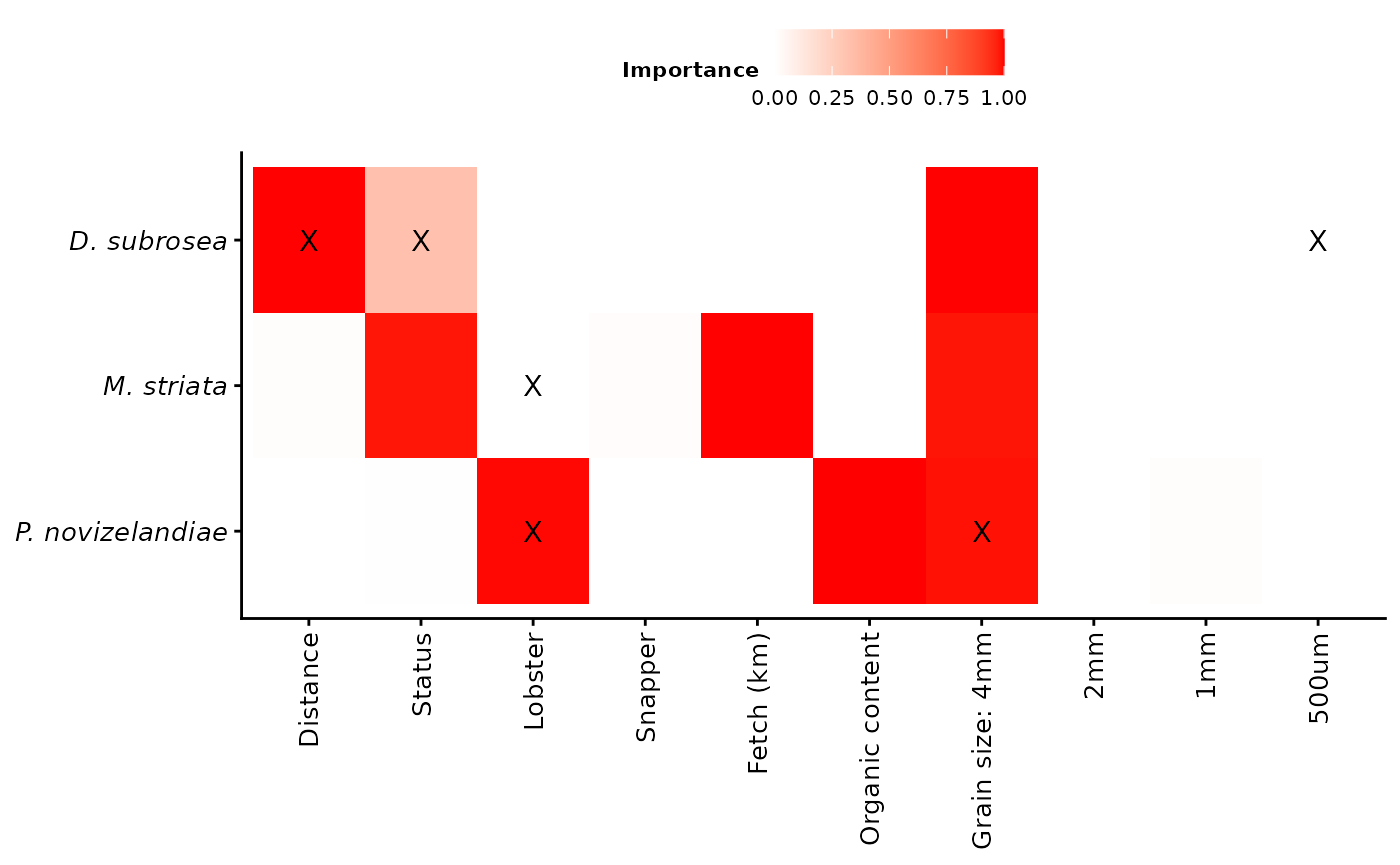
Part 3 - plots of the most parsimonious models
Make a suitable theme. The text sizes are set for the assembled multi-panel figure below rather than for a single plot: at 15 pt the axis titles are wider than a one-third-width panel and are clipped. The legend is turned off here and drawn once for the whole figure instead, because a per-panel legend is drawn over the data.
Theme1 <- theme(
  panel.grid.major = element_blank(),
  panel.grid.minor = element_blank(),
  legend.background = element_blank(),
  legend.key = element_blank(),
  legend.text = element_text(size = 12),
  legend.title = element_blank(),
  legend.position = "none",
  text = element_text(size = 12),
  strip.text.y = element_text(size = 12, angle = 0),
  axis.title.x = element_text(vjust = 0.3, size = 12),
  axis.title.y = element_text(vjust = 0.6, angle = 90, size = 12),
  axis.text.x = element_text(size = 11),
  axis.text.y = element_text(size = 11),
  axis.line.x = element_line(colour = "black", linewidth = 0.5, linetype = "solid"),
  axis.line.y = element_line(colour = "black", linewidth = 0.5, linetype = "solid"),
  strip.background = element_blank()
)
name<-"clams"
Manually make the most parsimonious GAM models for each taxa
MODEL Bivalve.Dosina.subrosea 500um + Distance x Status
dat.bds<-dat%>%filter(Taxa=="BDS")
gamm=gam(response~s(sqrt.X500um,k=3,bs='cr')+s(Distance,k=1,bs='cr', by=Status)+ s(Location,Site,bs="re")+ Status, family=tw(),data=dat.bds)
Predict - status from MODEL Bivalve.Dosina.subrosea—-
mod<-gamm
testdata <- expand.grid(Distance=mean(mod$model$Distance),
                        sqrt.X500um=mean(mod$model$sqrt.X500um),
                        Location=(mod$model$Location),
                        Site=(mod$model$Site),
                        Status = c("Fished","No-take"))%>%
  distinct()%>%
  glimpse()
## Rows: 144
## Columns: 5
## $ Distance <dbl> 12.97895, 12.97895, 12.97895, 12.97895, 12.97895, 12.97895…
## $ sqrt.X500um <dbl> 2.855525, 2.855525, 2.855525, 2.855525, 2.855525, 2.855525…
## $ Location <fct> Hahei, Leigh, Tawharanui, Hahei, Leigh, Tawharanui, Hahei,…
## $ Site <fct> Cooks Beach Inner, Cooks Beach Inner, Cooks Beach Inner, C…
## $ Status <fct> Fished, Fished, Fished, Fished, Fished, Fished, Fished, Fi…
fits <- predict.gam(mod, newdata=testdata, type='response', se.fit=T)

predicts.bds.status = testdata%>%data.frame(fits)%>%
  group_by(Status)%>% #only change here
  summarise(response=mean(fit),se.fit=mean(se.fit))%>%
  ungroup()

predicts.bds.status %>%
  glimpse()
## Rows: 2
## Columns: 3
## $ Status <fct> Fished, No-take
## $ response <dbl> 2.8646047, 0.7276123
## $ se.fit <dbl> 2.390011, 0.619802predict - Distance.x.status from MODEL Bivalve.Dosina.subrosea—-
mod<-gamm
testdata <- expand.grid(Distance=seq(min(dat$Distance),max(dat$Distance),length.out = 20),
                        sqrt.X500um=mean(mod$model$sqrt.X500um),
                        Location=(mod$model$Location),
                        Site=(mod$model$Site),
                        Status = c("Fished","No-take"))%>%
  distinct()%>%
  glimpse()
## Rows: 2,880
## Columns: 5
## $ Distance <dbl> 2.000000, 3.473684, 4.947368, 6.421053, 7.894737, 9.368421…
## $ sqrt.X500um <dbl> 2.855525, 2.855525, 2.855525, 2.855525, 2.855525, 2.855525…
## $ Location <fct> Hahei, Hahei, Hahei, Hahei, Hahei, Hahei, Hahei, Hahei, Ha…
## $ Site <fct> Cooks Beach Inner, Cooks Beach Inner, Cooks Beach Inner, C…
## $ Status <fct> Fished, Fished, Fished, Fished, Fished, Fished, Fished, Fi…
fits <- predict.gam(mod, newdata=testdata, type='response', se.fit=T)

predicts.bds.Distance.x.status = testdata%>%data.frame(fits)%>%
  group_by(Distance,Status)%>%
  summarise(response=mean(fit),se.fit=mean(se.fit))%>%
  ungroup()
predicts.bds.Distance.x.status |>
  glimpse()
## Rows: 40
## Columns: 4
## $ Distance <dbl> 2.000000, 2.000000, 3.473684, 3.473684, 4.947368, 4.947368, 6…
## $ Status <fct> Fished, No-take, Fished, No-take, Fished, No-take, Fished, No…
## $ response <dbl> 2.0505723, 0.4356395, 2.1446873, 0.4666912, 2.2431218, 0.4999…
## $ se.fit <dbl> 1.7306685, 0.3823930, 1.8058795, 0.4073529, 1.8848049, 0.4341…Predict 500um from MODEL Bivalve.Dosina.subrosea—-
mod<-gamm
testdata <- expand.grid(sqrt.X500um=seq(min(dat$sqrt.X500um),max(dat$sqrt.X500um),length.out = 20),
                        Distance=mean(mod$model$Distance),
                        Location=(mod$model$Location),
                        Site=(mod$model$Site),
                        Status = c("Fished","No-take"))%>%
  distinct()%>%
  glimpse()
## Rows: 2,880
## Columns: 5
## $ sqrt.X500um <dbl> 0.4630875, 0.7521858, 1.0412841, 1.3303825, 1.6194808, 1.9…
## $ Distance <dbl> 12.97895, 12.97895, 12.97895, 12.97895, 12.97895, 12.97895…
## $ Location <fct> Hahei, Hahei, Hahei, Hahei, Hahei, Hahei, Hahei, Hahei, Ha…
## $ Site <fct> Cooks Beach Inner, Cooks Beach Inner, Cooks Beach Inner, C…
## $ Status <fct> Fished, Fished, Fished, Fished, Fished, Fished, Fished, Fi…
fits <- predict.gam(mod, newdata=testdata, type='response', se.fit=T)

predicts.bds.500um = testdata%>%data.frame(fits)%>%
  group_by(sqrt.X500um)%>%
  summarise(response=mean(fit),se.fit=mean(se.fit))%>%
  ungroup()
predicts.bds.500um %>%
  glimpse()
## Rows: 20
## Columns: 3
## $ sqrt.X500um <dbl> 0.4630875, 0.7521858, 1.0412841, 1.3303825, 1.6194808, 1.9…
## $ response <dbl> 4.6448757, 4.1410544, 3.6918819, 3.2914306, 2.9344158, 2.6…
## $ se.fit <dbl> 4.0647102, 3.5813495, 3.1606276, 2.7942131, 2.4748134, 2.1…MODEL Bivalve.Myadora.striata Lobster
##    sediment Location Status              Site Distance depth    X4mm    X2mm
## 1 -3.262500    Hahei Fished Cooks Beach Inner        2    12 3.16462 1.41119
## 2 -3.483828    Hahei Fished Cooks Beach Inner        5    12 1.69129 1.62811
##      X1mm  X500um   X250um  X125um   X63um   fetch     org snapper lobster
## 1 3.88962 8.69694 70.31984 6.19663 6.25038 2232582 3.45785       0       0
## 2 4.86726 9.92831 69.18594 5.70317 6.92941 2232582 3.19104       0       0
##   InPreds   BioTurb Taxa response sqrt.X4mm sqrt.X2mm sqrt.X1mm sqrt.X500um
## 1       0 0.1666667  BMS        6  1.778938  1.187935  1.972212    2.949057
## 2       0 0.1666667  BMS        4  1.300496  1.275974  2.206187    3.150922
gamm=gam(response~s(lobster,k=3,bs='cr')+ s(Location,Site,bs="re"), family=tw(),data=dat.bms)

# predict - lobster from model for Bivalve.Myadora.striata ----
mod<-gamm
testdata <- expand.grid(lobster=seq(min(dat$lobster),max(dat$lobster),length.out = 20),
                        Location=(mod$model$Location),
                        Site=(mod$model$Site),
                        Status = c("Fished","No-take"))%>%
  distinct()%>%
  glimpse()
## Rows: 2,880
## Columns: 4
## $ lobster <dbl> 0.0000000, 0.3421053, 0.6842105, 1.0263158, 1.3684211, 1.7105…
## $ Location <fct> Hahei, Hahei, Hahei, Hahei, Hahei, Hahei, Hahei, Hahei, Hahei…
## $ Site <fct> Cooks Beach Inner, Cooks Beach Inner, Cooks Beach Inner, Cook…
## $ Status <fct> Fished, Fished, Fished, Fished, Fished, Fished, Fished, Fishe…
fits <- predict.gam(mod, newdata=testdata, type='response', se.fit=T)
predicts.bms.lobster = testdata%>%data.frame(fits)%>%
  group_by(lobster)%>%
  summarise(response=mean(fit),se.fit=mean(se.fit))%>%
  ungroup()

predicts.bms.lobster %>%
  glimpse()
## Rows: 20
## Columns: 3
## $ lobster <dbl> 0.0000000, 0.3421053, 0.6842105, 1.0263158, 1.3684211, 1.7105…
## $ response <dbl> 1.93534254, 1.56507086, 1.26563993, 1.02349643, 0.82768005, 0…
## $ se.fit <dbl> 1.73352921, 1.38496562, 1.11267638, 0.89887748, 0.72994634, 0…MODEL Decapod.P.novazelandiae 4mm + Lobster
##    sediment Location Status              Site Distance depth    X4mm    X2mm
## 1 -3.262500    Hahei Fished Cooks Beach Inner        2    12 3.16462 1.41119
## 2 -3.483828    Hahei Fished Cooks Beach Inner        5    12 1.69129 1.62811
##      X1mm  X500um   X250um  X125um   X63um   fetch     org snapper lobster
## 1 3.88962 8.69694 70.31984 6.19663 6.25038 2232582 3.45785       0       0
## 2 4.86726 9.92831 69.18594 5.70317 6.92941 2232582 3.19104       0       0
##   InPreds   BioTurb Taxa response sqrt.X4mm sqrt.X2mm sqrt.X1mm sqrt.X500um
## 1       0 0.1666667  CPN        3  1.778938  1.187935  1.972212    2.949057
## 2       0 0.1666667  CPN       11  1.300496  1.275974  2.206187    3.150922
gamm=gam(response~s(sqrt.X4mm,k=3,bs='cr')+s(lobster,k=3,bs='cr')+ s(Location,Site,bs="re"), family=tw(),data=dat.cpn)Predict - sqrt.X4mm from model for Decapod.P.novazelandiae —-
mod<-gamm
testdata <- expand.grid(sqrt.X4mm=seq(min(dat$sqrt.X4mm),max(dat$sqrt.X4mm),length.out = 20),
                        lobster=mean(mod$model$lobster),
                        Location=(mod$model$Location),
                        Site=(mod$model$Site),
                        Status = c("Fished","No-take"))%>%
  distinct()%>%
  glimpse()
## Rows: 2,880
## Columns: 5
## $ sqrt.X4mm <dbl> 0.00000000, 0.09362831, 0.18725662, 0.28088493, 0.37451324, …
## $ lobster <dbl> 1.909474, 1.909474, 1.909474, 1.909474, 1.909474, 1.909474, …
## $ Location <fct> Hahei, Hahei, Hahei, Hahei, Hahei, Hahei, Hahei, Hahei, Hahe…
## $ Site <fct> Cooks Beach Inner, Cooks Beach Inner, Cooks Beach Inner, Coo…
## $ Status <fct> Fished, Fished, Fished, Fished, Fished, Fished, Fished, Fish…
fits <- predict.gam(mod, newdata=testdata, type='response', se.fit=T)
predicts.cpn.4mm = testdata%>%data.frame(fits)%>%
  group_by(sqrt.X4mm)%>% #only change here
  summarise(response=mean(fit),se.fit=mean(se.fit))%>%
  ungroup()
predicts.cpn.4mm %>%
  glimpse()
## Rows: 20
## Columns: 3
## $ sqrt.X4mm <dbl> 0.00000000, 0.09362831, 0.18725662, 0.28088493, 0.37451324, …
## $ response <dbl> 4.822420, 4.499149, 4.197548, 3.916164, 3.653641, 3.408715, …
## $ se.fit <dbl> 3.235051, 2.979428, 2.751207, 2.547690, 2.366325, 2.204703, …Predict - lobster from model for Decapod.P.novazelandiae —-
mod<-gamm
testdata <- expand.grid(lobster=seq(min(dat$lobster),max(dat$lobster),length.out = 20),
                        sqrt.X4mm=mean(mod$model$sqrt.X4mm),
                        Location=(mod$model$Location),
                        Site=(mod$model$Site),
                        Status = c("Fished","No-take"))%>%
  distinct()%>%
  glimpse()
## Rows: 2,880
## Columns: 5
## $ lobster <dbl> 0.0000000, 0.3421053, 0.6842105, 1.0263158, 1.3684211, 1.710…
## $ sqrt.X4mm <dbl> 0.4572685, 0.4572685, 0.4572685, 0.4572685, 0.4572685, 0.457…
## $ Location <fct> Hahei, Hahei, Hahei, Hahei, Hahei, Hahei, Hahei, Hahei, Hahe…
## $ Site <fct> Cooks Beach Inner, Cooks Beach Inner, Cooks Beach Inner, Coo…
## $ Status <fct> Fished, Fished, Fished, Fished, Fished, Fished, Fished, Fish…
fits <- predict.gam(mod, newdata=testdata, type='response', se.fit=T)
predicts.cpn.lobster = testdata%>%data.frame(fits)%>%
  group_by(lobster)%>%
  summarise(response=mean(fit),se.fit=mean(se.fit))%>%
  ungroup()
predicts.cpn.lobster %>%
  glimpse()
## Rows: 20
## Columns: 3
## $ lobster <dbl> 0.0000000, 0.3421053, 0.6842105, 1.0263158, 1.3684211, 1.7105…
## $ response <dbl> 4.560408, 4.334946, 4.120627, 3.916900, 3.723238, 3.539142, 3…
## $ se.fit <dbl> 3.038395, 2.857564, 2.693471, 2.544742, 2.410040, 2.288081, 2…PLOTS for Bivalve.Dosina.subrosea 500um + Distance x Status
ggmod.bds.status<- ggplot(aes(x=Status,y=response,fill=Status,colour=Status), data=predicts.bds.status) +
  ylab("Abundance")+
  xlab('Status')+
  scale_fill_manual(labels = c("Fished", "No-take"),values=c("red", "black"))+
  scale_colour_manual(labels = c("Fished", "No-take"),values=c("red", "black"))+
  scale_x_discrete(limits = rev(levels(predicts.bds.status$Status)))+
  geom_bar(stat = "identity")+
  geom_errorbar(aes(ymin = response-se.fit,ymax = response+se.fit),width = 0.5) +
  # bars start at zero, so expand only at the top, clear of the error bar
  scale_y_continuous(expand = expansion(mult = c(0, 0.15)))+
  theme_classic()+
  Theme1+
  annotate("text", x = -Inf, y=Inf, label = "(a)",vjust = 1, hjust = -.1,size=5)+
  annotate("text", x = -Inf, y=Inf, label = "   Dosinia subrosea",vjust = 1, hjust = -.1,size=5,fontface="italic")
ggmod.bds.status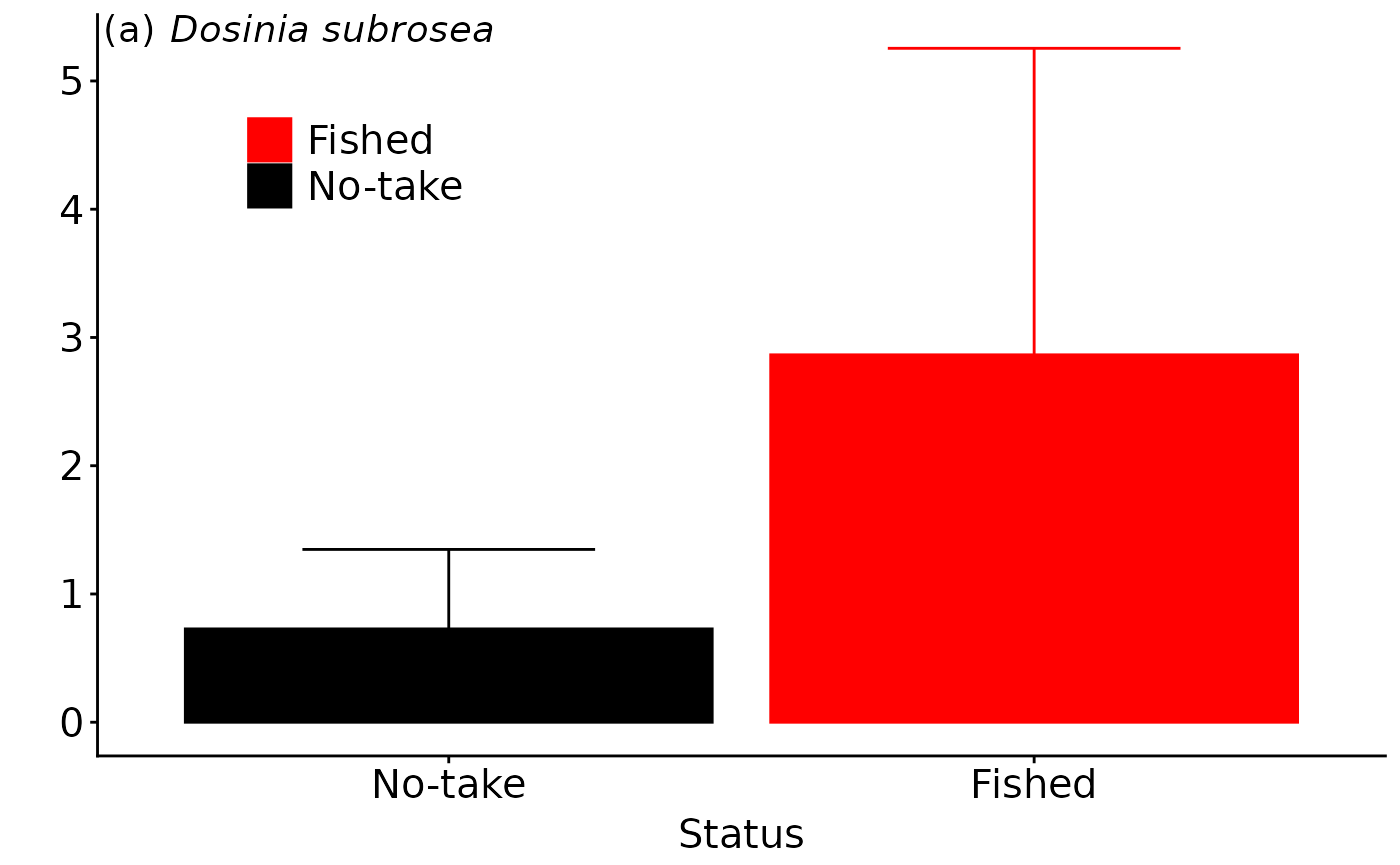
ggmod.bds.Distance.x.status<- ggplot(aes(x=Distance,y=response,colour=Status), data=dat.bds) +
  ylab(" ")+
  xlab('Distance (m)')+
  scale_color_manual(labels = c("Fished", "No-take"),values=c("red", "black"))+
  geom_jitter(width = 0.25,height = 0,alpha=0.75, size=2,show.legend=FALSE)+
  # geom_point(alpha=0.75, size=2)+
  geom_line(data=predicts.bds.Distance.x.status,show.legend=FALSE)+
  geom_line(data=predicts.bds.Distance.x.status,aes(y=response - se.fit),linetype="dashed",show.legend=FALSE)+
  geom_line(data=predicts.bds.Distance.x.status,aes(y=response + se.fit),linetype="dashed",show.legend=FALSE)+
  # headroom at the top of the panel so the (a)-(f) labels sit clear of the data
  scale_y_continuous(expand = expansion(mult = c(0.03, 0.13)))+
  theme_classic()+
  Theme1+
  annotate("text", x = -Inf, y=Inf, label = "(b)",vjust = 1, hjust = -.1,size=5)
ggmod.bds.Distance.x.status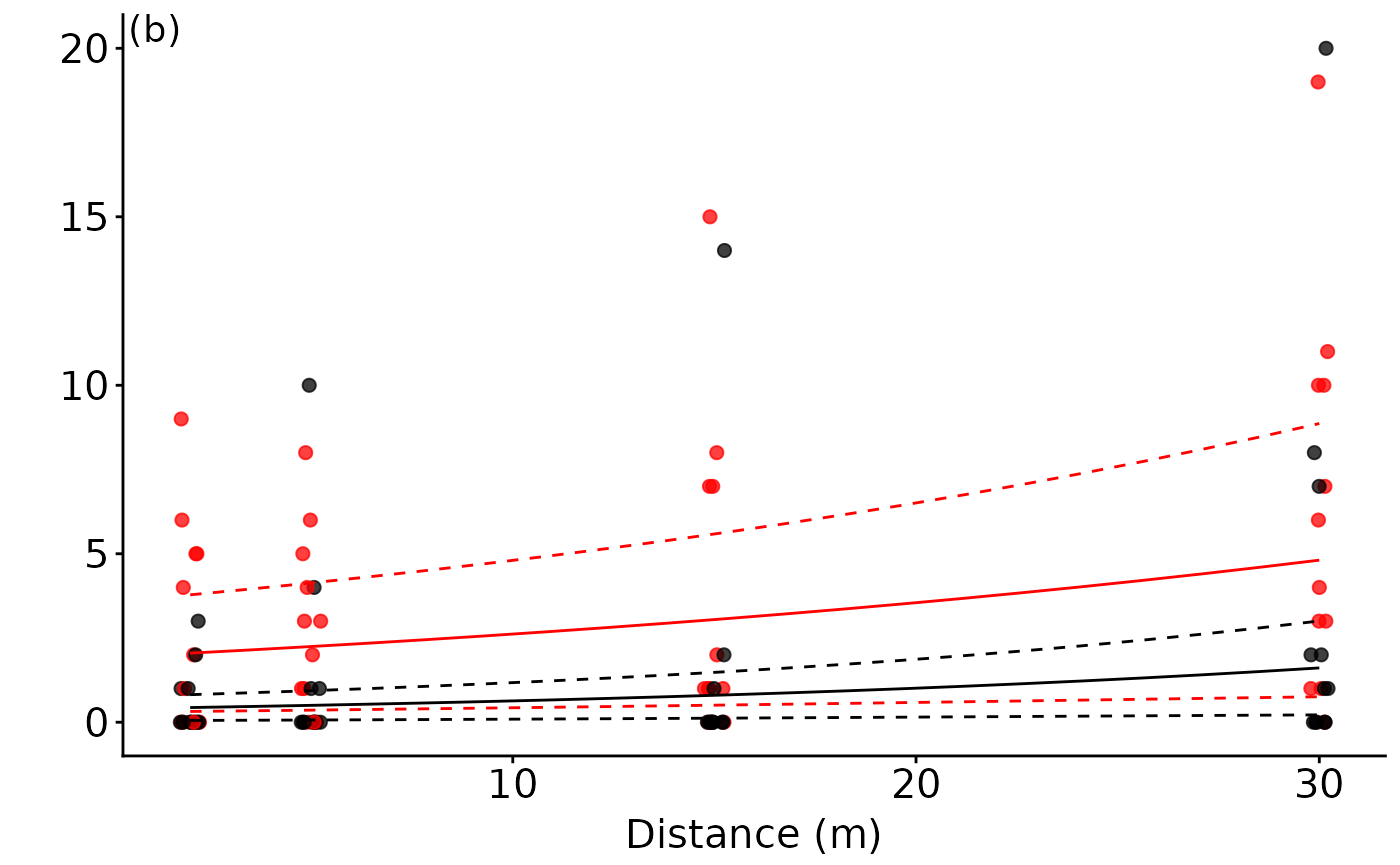
ggmod.bds.500um<- ggplot() +
  ylab(" ")+
  xlab('Grain size: 500 um (sqrt)')+
  scale_color_manual(labels = c("Fished", "No-take"),values=c("red", "black"))+
  geom_point(data=dat.bds,aes(x=sqrt.X500um,y=response,colour=Status),  alpha=0.75, size=2,show.legend=FALSE)+
  geom_line(data=predicts.bds.500um,aes(x=sqrt.X500um,y=response),alpha=0.5)+
  geom_line(data=predicts.bds.500um,aes(x=sqrt.X500um,y=response - se.fit),linetype="dashed",alpha=0.5)+
  geom_line(data=predicts.bds.500um,aes(x=sqrt.X500um,y=response + se.fit),linetype="dashed",alpha=0.5)+
  # headroom at the top of the panel so the (a)-(f) labels sit clear of the data
  scale_y_continuous(expand = expansion(mult = c(0.03, 0.13)))+
  theme_classic()+
  Theme1+
  annotate("text", x = -Inf, y=Inf, label = "(c)",vjust = 1, hjust = -.1,size=5)
ggmod.bds.500um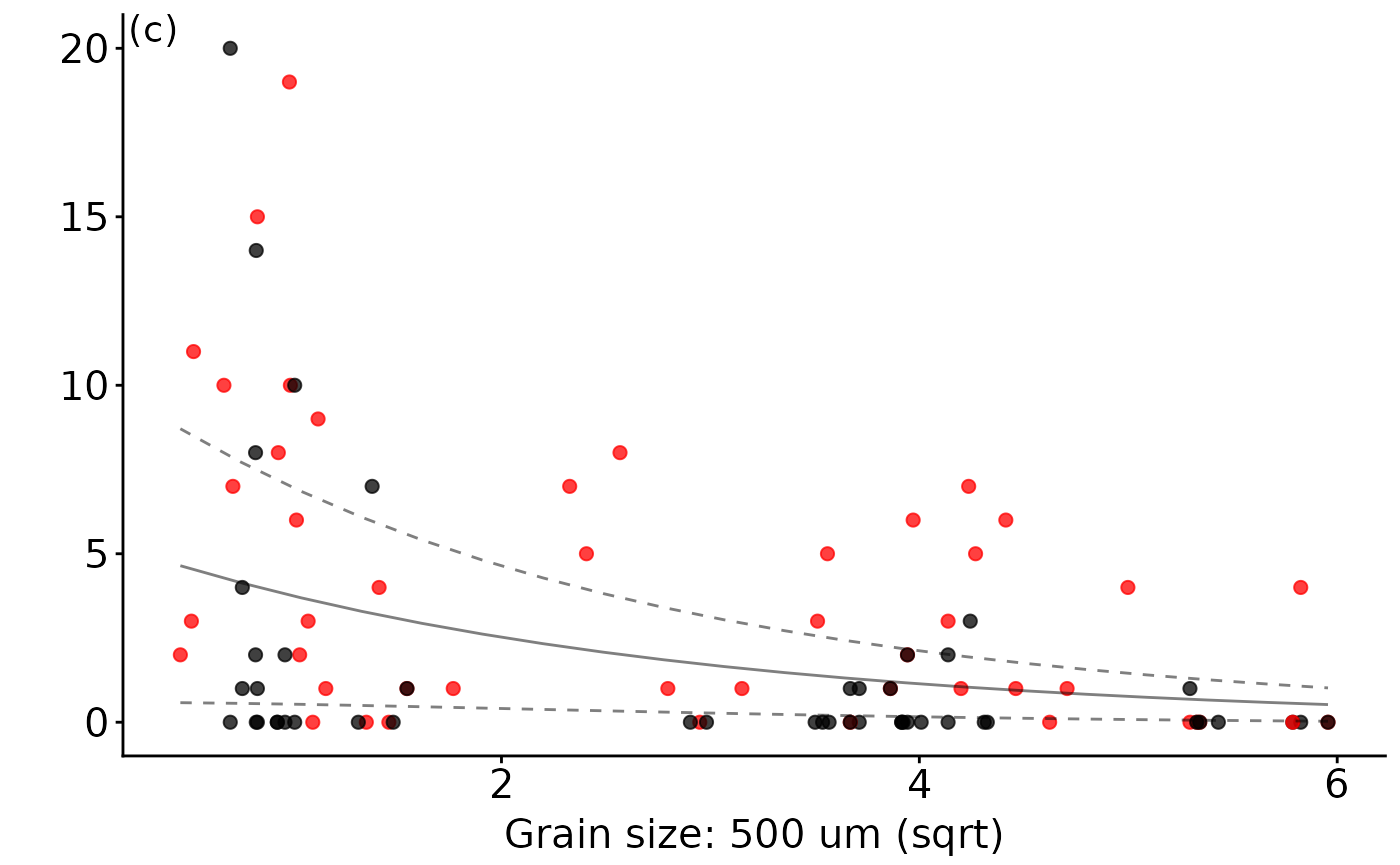
PLOTS Bivalve M.striata lobster
ggmod.bms.lobster<- ggplot() +
  ylab("Abundance")+
  xlab(bquote('Density of legal lobster (no./25' *m^-2*')'))+
  scale_color_manual(labels = c("Fished", "SZ"),values=c("red", "black"))+
  geom_point(data=dat.bms,aes(x=lobster,y=response,colour=Status),  alpha=0.75, size=2,show.legend=FALSE)+
  geom_line(data=predicts.bms.lobster,aes(x=lobster,y=response),alpha=0.5)+
  geom_line(data=predicts.bms.lobster,aes(x=lobster,y=response - se.fit),linetype="dashed",alpha=0.5)+
  geom_line(data=predicts.bms.lobster,aes(x=lobster,y=response + se.fit),linetype="dashed",alpha=0.5)+
  # headroom at the top of the panel so the (a)-(f) labels sit clear of the data
  scale_y_continuous(expand = expansion(mult = c(0.03, 0.13)))+
  theme_classic()+
  Theme1+
  annotate("text", x = -Inf, y=Inf, label = "(d)",vjust = 1, hjust = -.1,size=5)+
  annotate("text", x = -Inf, y=Inf, label = "   Myadora striata",vjust = 1, hjust = -.1,size=5,fontface="italic")+
  geom_blank(data=dat.bms,aes(x=lobster,y=response*1.05))#to nudge data off annotations
ggmod.bms.lobster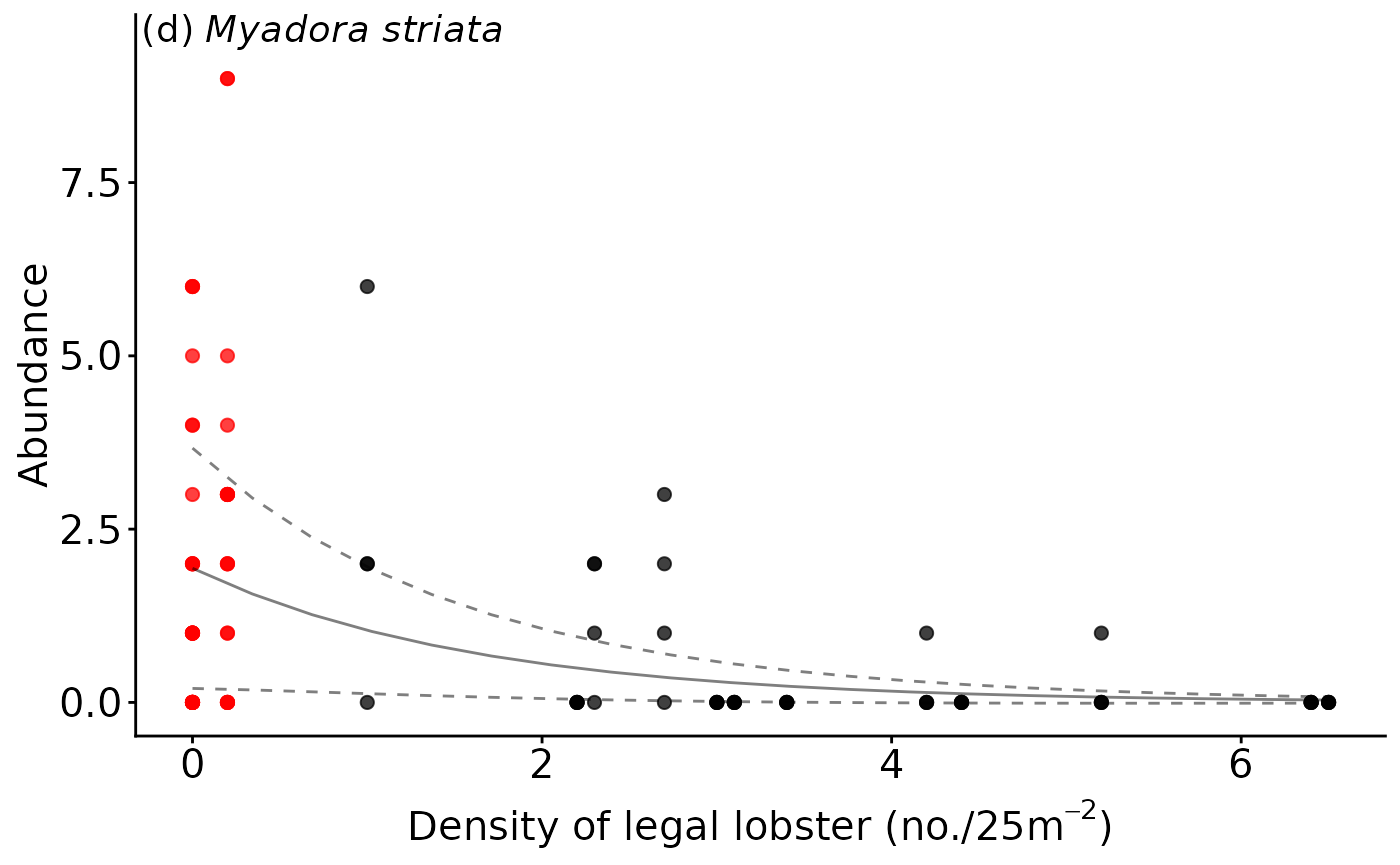
PLOTS Decapod.P.novazelandiae 4mm + lobster
ggmod.cpn.lobster<- ggplot() +
  ylab("Abundance")+
  xlab(bquote('Density of legal lobster (no./25' *m^-2*')'))+
  scale_color_manual(labels = c("Fished", "SZ"),values=c("red", "black"))+
  geom_point(data=dat.cpn,aes(x=lobster,y=response,colour=Status),  alpha=0.75, size=2,show.legend=FALSE)+
  geom_line(data=predicts.cpn.lobster,aes(x=lobster,y=response),alpha=0.5)+
  geom_line(data=predicts.cpn.lobster,aes(x=lobster,y=response - se.fit),linetype="dashed",alpha=0.5)+
  geom_line(data=predicts.cpn.lobster,aes(x=lobster,y=response + se.fit),linetype="dashed",alpha=0.5)+
  # headroom at the top of the panel so the (a)-(f) labels sit clear of the data
  scale_y_continuous(expand = expansion(mult = c(0.03, 0.13)))+
  theme_classic()+
  Theme1+
  annotate("text", x = -Inf, y=Inf, label = "(e)",vjust = 1, hjust = -.1,size=5)+
  annotate("text", x = -Inf, y=Inf, label = "  Pagurus novizelandiae",vjust = 1, hjust = -.1,size=5,fontface="italic")+
  geom_blank(data=dat.cpn,aes(x=lobster,y=response*1.05))#to nudge data off annotations
ggmod.cpn.lobster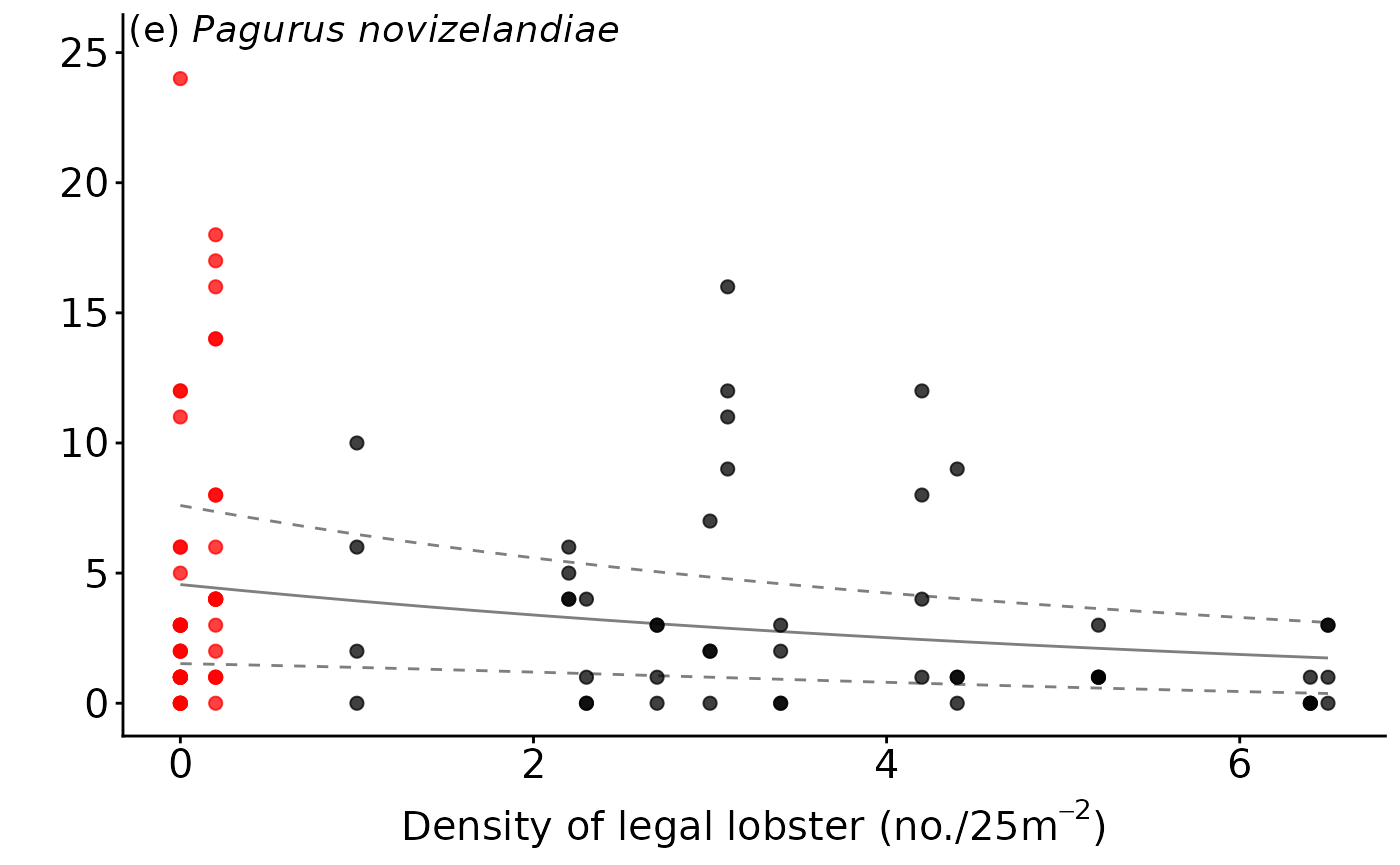
ggmod.cpn.4mm<- ggplot() +
  ylab(" ")+
  xlab('Grain size: 4 mm (sqrt)')+
  scale_color_manual(labels = c("Fished", "No-take"),values=c("red", "black"))+
  geom_point(data=dat.cpn,aes(x=sqrt.X4mm,y=response,colour=Status),  alpha=0.75, size=2,show.legend=FALSE)+
  geom_line(data=predicts.cpn.4mm,aes(x=sqrt.X4mm,y=response),alpha=0.5)+
  geom_line(data=predicts.cpn.4mm,aes(x=sqrt.X4mm,y=response - se.fit),linetype="dashed",alpha=0.5)+
  geom_line(data=predicts.cpn.4mm,aes(x=sqrt.X4mm,y=response + se.fit),linetype="dashed",alpha=0.5)+
  # headroom at the top of the panel so the (a)-(f) labels sit clear of the data
  scale_y_continuous(expand = expansion(mult = c(0.03, 0.13)))+
  theme_classic()+
  Theme1+
  annotate("text", x = -Inf, y=Inf, label = "(f)",vjust = 1, hjust = -.1,size=5)+
  annotate("text", x = -Inf, y=Inf, label = " ",vjust = 1, hjust = -.1,size=5,fontface="italic")
ggmod.cpn.4mm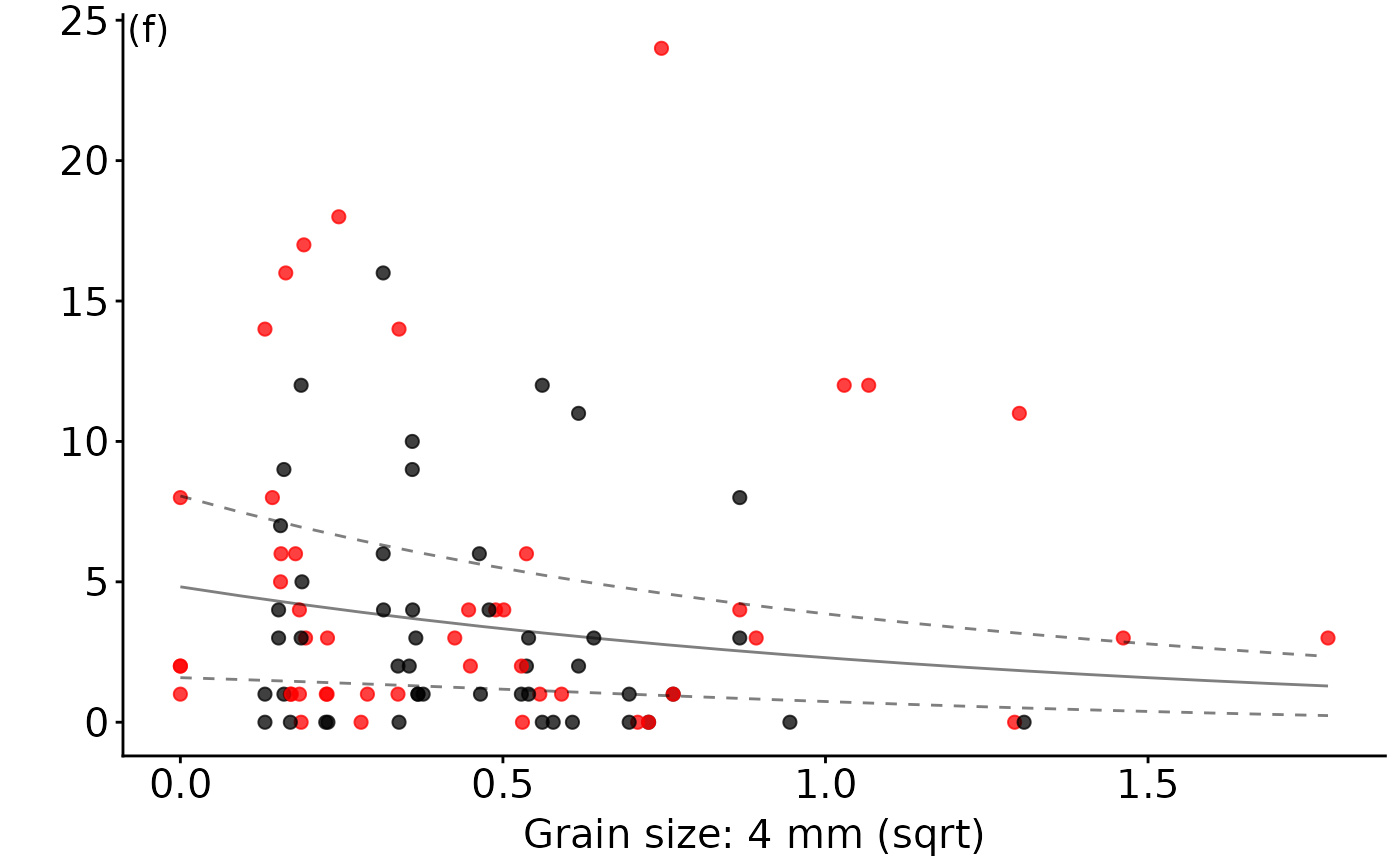
Combined.plot using grid() and gridExtra()
The six panels are assembled with one row per taxon, so the second
and third rows hold fewer panels than the first.
layout_matrix places each panel and leaves the unused cells
empty. Note that grid.rect() is not a way to fill an unused
cell: it draws to the device as a side effect as well as returning a
grob, so it emits a stray blank plot of its own.
The Status key is drawn once for the whole figure and placed in one
of the empty cells, rather than inside panel (a) where it obscures the
bars. ggplotGrob() builds a panel as a gtable, from which
the legend can be taken and then positioned like any other panel.
Set the figure large enough for three columns of panels. At the
default size the axis titles are wider than a panel and are cut off. In
an interactive session, make the plot window large before running
grid.arrange() or it will error.
# Take the Status key out of panel (a) so it can be placed in an empty cell.
legend.panel <- ggplotGrob(ggmod.bds.status +
                             theme(legend.position = "top",
                                   legend.direction = "horizontal"))
guide.box <- which(grepl("guide-box", legend.panel$layout$name))
guide.box <- guide.box[!vapply(legend.panel$grobs[guide.box],
                               inherits, logical(1), "zeroGrob")][1]
status.legend <- legend.panel$grobs[[guide.box]]

panel.layout <- rbind(c(1, 2, 3),
                      c(4, 7, NA),
                      c(5, 6, NA))

grid.arrange(ggmod.bds.status, ggmod.bds.Distance.x.status, ggmod.bds.500um,
             ggmod.bms.lobster, ggmod.cpn.lobster, ggmod.cpn.4mm, status.legend,
             layout_matrix = panel.layout)
Use arrangeGrob ONLY - as we can pass this to ggsave! Note use of raw ggplot’s
arrangeGrob() returns the assembled figure rather than
drawing it, so printing the object lists the gtable structure instead of
producing a plot. Draw it with grid::grid.draw(), or pass
it to ggsave() to write it to a file.
combine.plot <- arrangeGrob(ggmod.bds.status, ggmod.bds.Distance.x.status,
                            ggmod.bds.500um, ggmod.bms.lobster,
                            ggmod.cpn.lobster, ggmod.cpn.4mm, status.legend,
                            layout_matrix = panel.layout)

grid.draw(combine.plot)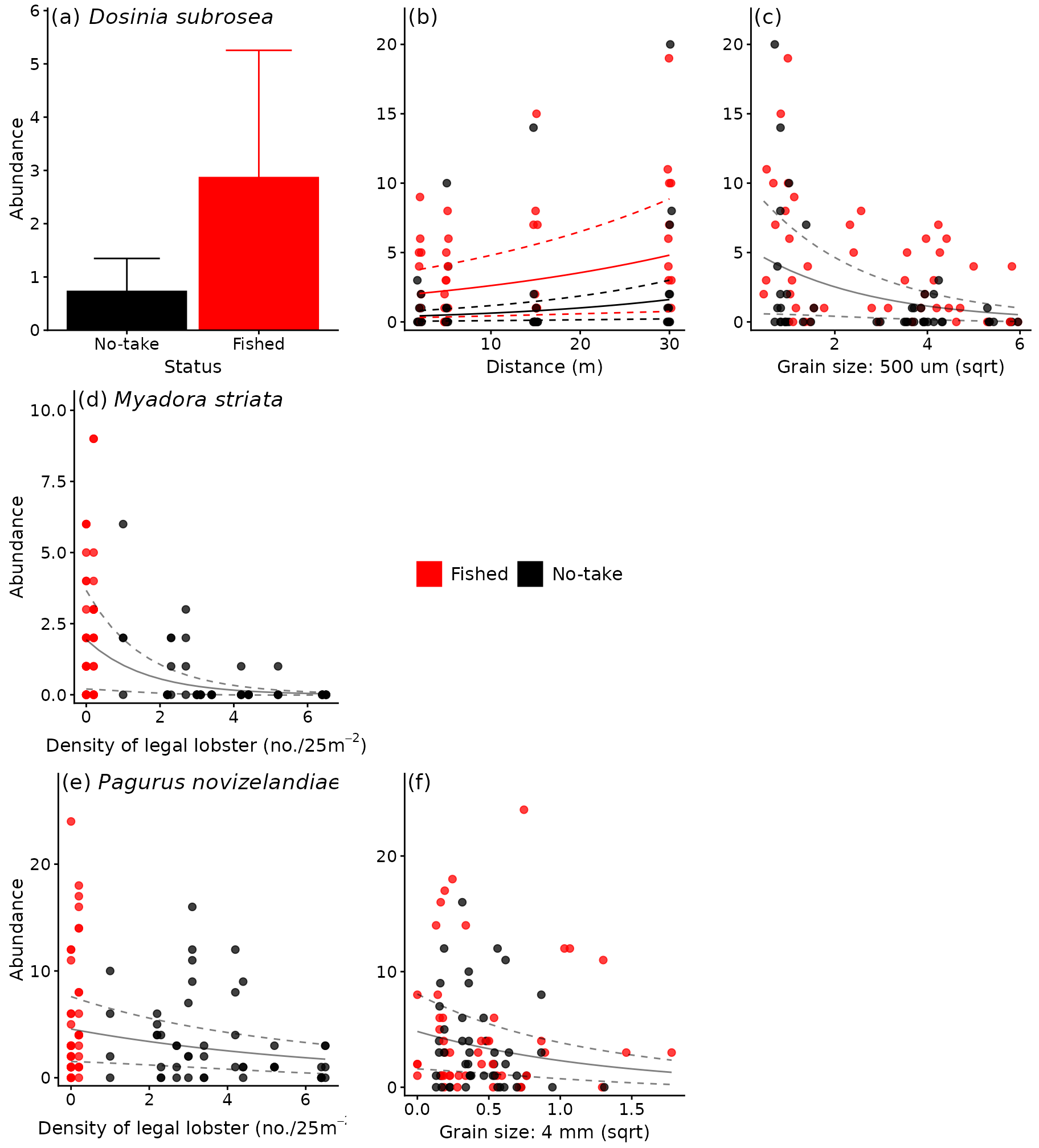
# ggsave("combined_plot.png", combine.plot, width = 9.5, height = 10.5, dpi = 300)Results and discussion
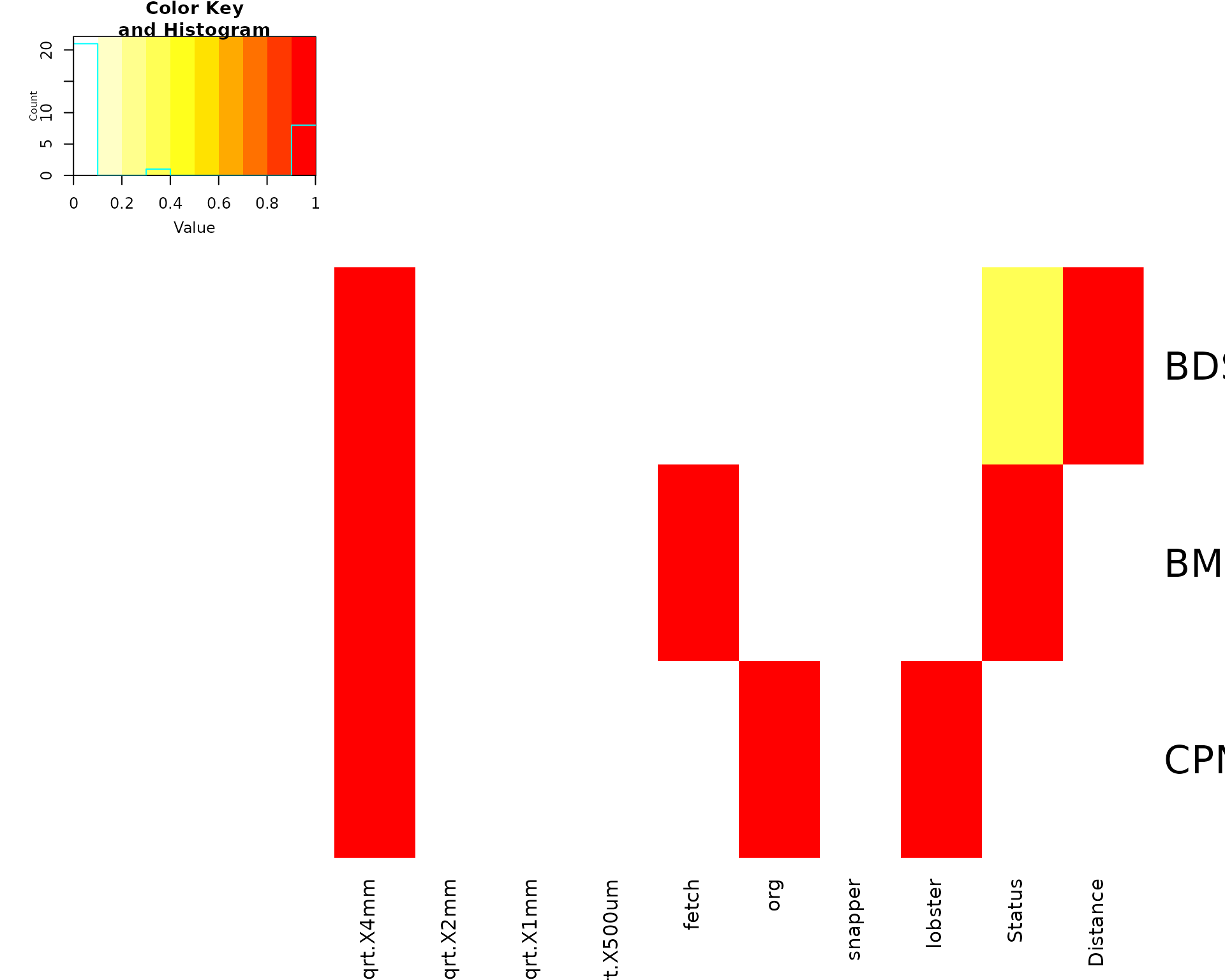
The most parsimonious model for the bivalve Dosinia subrosea included the interaction of distance from reef with NTR status and the 500 um sediment grain size fraction, which (along with random site effects) explained 52% of its distribution (see the model summary table above). While fetch occurred in the second top model, importance scores indicated that it was relatively unimportant compared to distance and NTR status (see the variable importance heatmap above). The abundance of D. subrosea was negatively correlated with increasing proportion of the 500 um sediment grain size fraction and positively correlated with increasing distance from the reef edge (see the plots above). Subsequent manipulative studies have found that D. subrosea are readily preyed upon by the large-bodied rock lobster in the field (Langlois, Anderson, Babcock, et al. 2006) and laboratory (Langlois, Anderson, Brock, et al. 2006), supporting the results of this analysis.
NTR status, distance and organic content were found to be important across all possible models explaining the abundance of Myadora striata, and had strong model support according to AICc. However a simpler model of decreasing abundance of M. striata with increasing density of legal-sized rock lobster was the most parsimonious model within 2 AICc, and had relatively high model support based on BIC. A direct relationship with the density of legal-sized rock lobster is consistent with the observation that greater than legal-size rock lobster can readily prey upon bivalves (Langlois, Anderson, Brock, et al. 2006).
There was a high level of model uncertainty in the full subsets analysis of the ubiquitous hermit crab Pagurus novizelandiae, with very low model weights and low, relatively evenly distributed variable importance scores. This is consistent with the original study that found no effect of NTR status on the abundance of Pagurus novizelandiae. The best model included the 4 mm sediment grain size fraction and the density of legal-sized rock lobster, explaining 48% of the distribution of P. novizelandiae. The abundance of P. novizelandiae was negatively correlated with increasing proportion of the 4 mm sediment grain size fraction and negatively correlated with the density of rock lobster on the reef edge. The direct relationship between the density of legal-sized rock lobster and the hermit crab P. novizelandiae is consistent with feeding studies of rock lobster, which indicated that they can exhibit a strong preference for decapod prey (Dumas et al. 2013).
Overall the general results of the revised analysis are comparable to those from the original study. However, by allowing environmental information to be included in the new analysis, whilst accounting for the nesting and random allocation of sites and NTR locations, a more informed comparison of the abundance of ubiquitous infaunal taxa has been made possible. In particular, it is useful that instead of relying on a simple comparison of NTR status to test hypotheses regarding predation of infauna, the role of the large carnivorous species protected within the NTR (e.g. rock lobster) can be more clearly indicated once it is included as a predictor variable in the models.